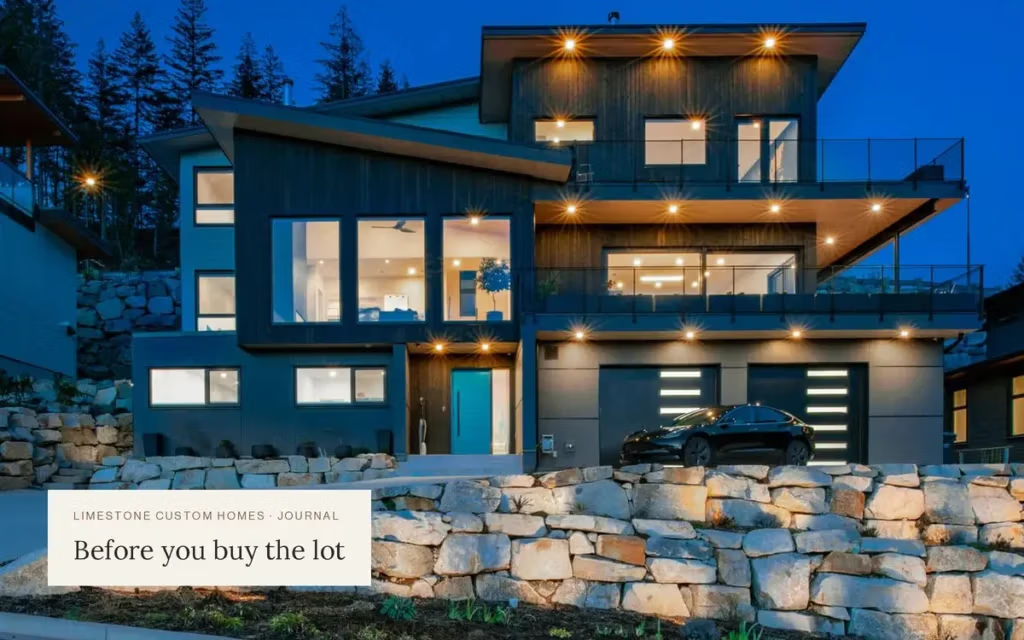
By Limestone Custom Homes · Updated November 2026
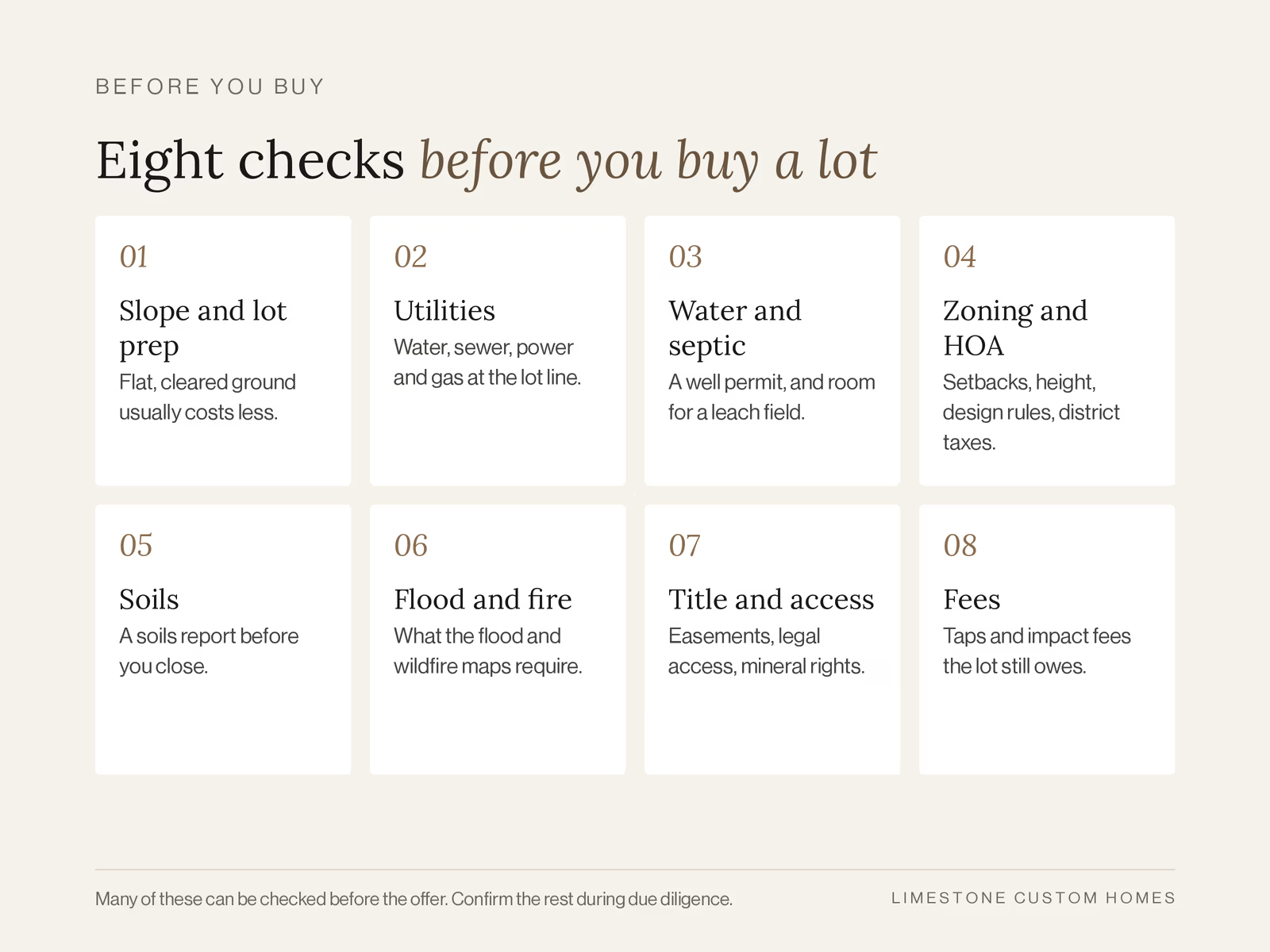
The short answer. The price of a lot is only part of what it costs you. Before you buy land to build on in Colorado, check eight things: the slope and lot prep, the utilities, water and septic, the zoning and HOA rules, the soils, the flood and wildfire maps, the title, and the fees the lot still owes. Many can be checked before you make an offer, and the rest confirmed during the contract’s due-diligence period, before your money is at risk.
Two lots at the same price can lead to very different homes. The lot is one of the main reasons the same house can cost $1M or $2M to build.
How to buy land and build a house, in order
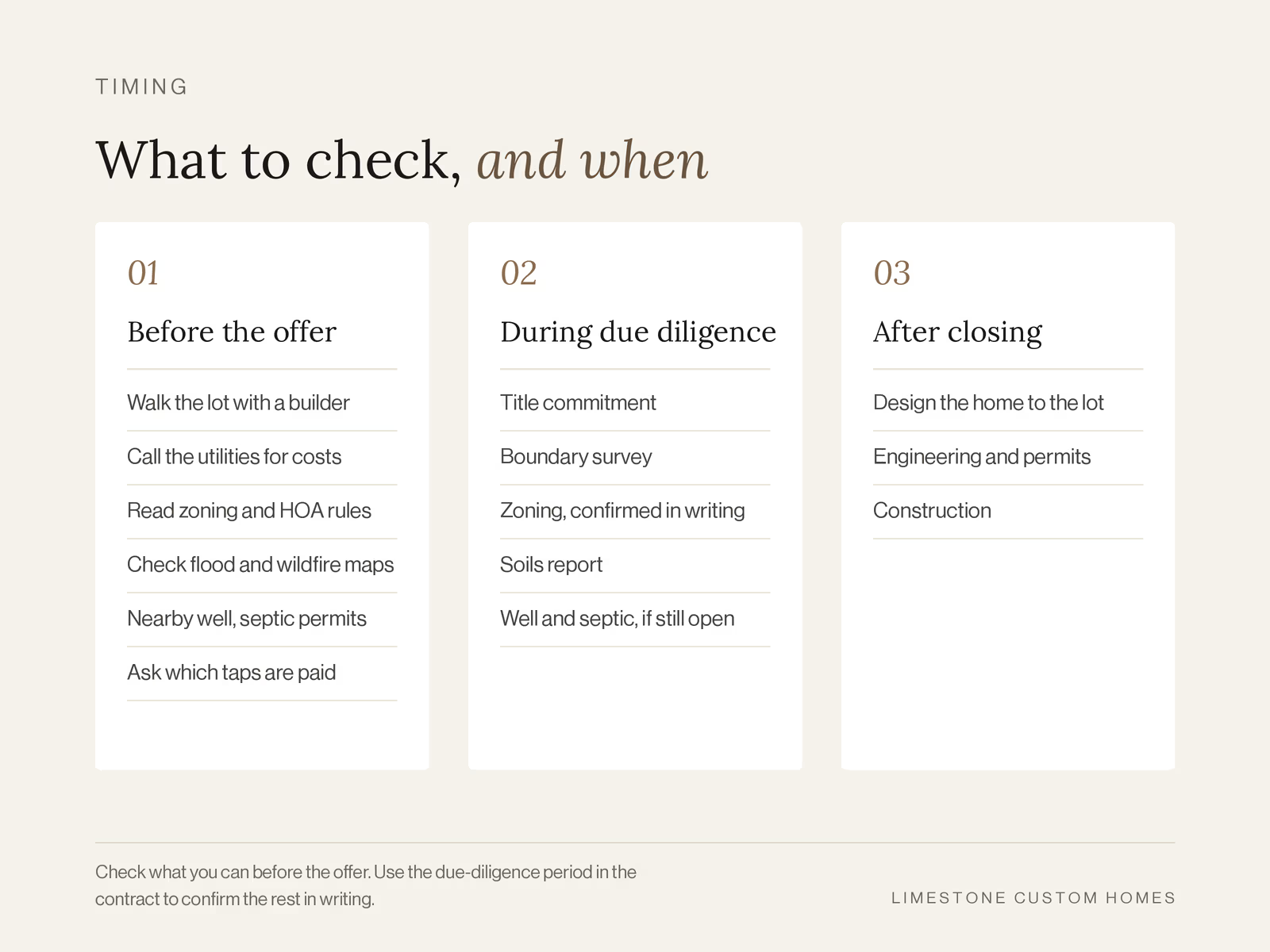
- Set the whole budget first. Land, construction, fees, and design all come out of the same number.
- Check what you can before the offer. Walk the lot with a builder you trust. Call the utilities, read the zoning and HOA rules, look up the flood and wildfire maps, and look at well and septic permits on neighboring lots. Most of this costs only time.
- Write the offer with a due-diligence period. Colorado’s standard land contract, written by the state Real Estate Commission, sets deadlines for title, survey, and due diligence.
- Confirm the rest in writing. The survey and the zoning must be confirmed, along with the title and the soils. If something serious turns up, you can renegotiate or walk away.
- Close, then design. The home is drawn for the lot, engineered, permitted, and built.
1. The slope and the lot prep
A flat lot is usually the least expensive ground to build on. A slope means more excavation, a stepped foundation, retaining walls, and often a longer driveway.
Usually is not always. A flat lot on poor soil can cost more to build on than a sloped lot on good soil, so read the grade and the soils report together.
Lot prep counts too. A lot full of trees, rock, or an old structure has to be cleared before anything else can start. Walk the lot, and ask for a topographic survey if the grade is more than gentle.
2. The utilities
An easy lot has water, sewer, power, and gas at the lot line. A complicated one needs long runs to bring them in. Call each utility company before you make an offer. They can tell you whether service reaches the lot and what it costs to connect.
3. Water and septic
Rural lots often need a well and a septic system. Permits on neighboring lots are a good guide to what yours will need: how deep the wells go, and what kind of septic system the ground takes. Where there are none nearby, settle both during due diligence.
- The well. Every new well needs a permit from the state. In most of Colorado, a new well on a lot under 35 acres is permitted for household use only, which means no watering outside. On 35 acres or more, a permit usually also covers up to an acre of lawn and garden. The Denver Basin is different. It runs along the Front Range from Greeley to Colorado Springs, Douglas County included, and what a well there may be used for depends on the water under the land. Check the specific parcel with the state. Colorado State University Extension explains the permits in plain terms.
- The septic system. The county health department issues the permit. State rules call for a site and soil evaluation on every lot where a system is proposed. They also keep a well and a leach field at least 100 feet apart, so check that the lot has room for both.
4. Zoning, setbacks, and HOA rules
Zoning decides what you can build: how large, how tall, and how far from each property line. Many neighborhoods add their own design review on top. Read both before you make an offer, then confirm the zoning with the town or county before you close.
Two more things to ask. First, whether the lot sits in a metropolitan district, which adds its own property tax to pay for roads and water lines. Second, whether the zoning allows an accessory dwelling, if a guest house or studio is part of the plan.
5. The soils
The Colorado Geological Survey calls swelling clay the state’s most significant geologic hazard. Where it is present, the foundation is engineered to the soils report and costs more than a standard footing. Order the report from a geotechnical engineer during due diligence, in Douglas County and in Larimer County alike.
6. Flood and wildfire maps
- Flood. Look the lot up on FEMA’s flood map. Inside a mapped floodplain, Colorado’s rules put the lowest floor of a new home, basement included, at least one foot above the flood elevation.
- Wildfire. Colorado adopted a statewide Wildfire Resiliency Code in 2025. Inside a mapped wildfire zone, the roof, vents, siding, and decks have to meet fire ratings. The higher the mapped risk, the more of the exterior is covered.
7. Title, access, and mineral rights
- Title. The title commitment lists easements and covenants that limit where and what you can build.
- Access. Confirm the lot has recorded, legal access to a public road.
- Survey. The boundaries must be confirmed. An improvement location certificate is not a boundary survey, so on raw land, order the survey.
- Mineral rights. In Colorado they can be owned separately from the surface, and the law gives the mineral owner reasonable use of the surface. The Douglas County Assessor explains how to check.
8. The fees the lot still owes
Some lots are sold with water and sewer taps already paid. Many are not. On a typical 2,400 square foot home, a 2025 study by the Home Builders Association of Metro Denver found permit, tax, impact, and water tap fees averaging about $68,000 across the metro area, and about $94,000 in Castle Rock. A larger custom home pays more. Ask the seller which taps are paid and get it in writing.
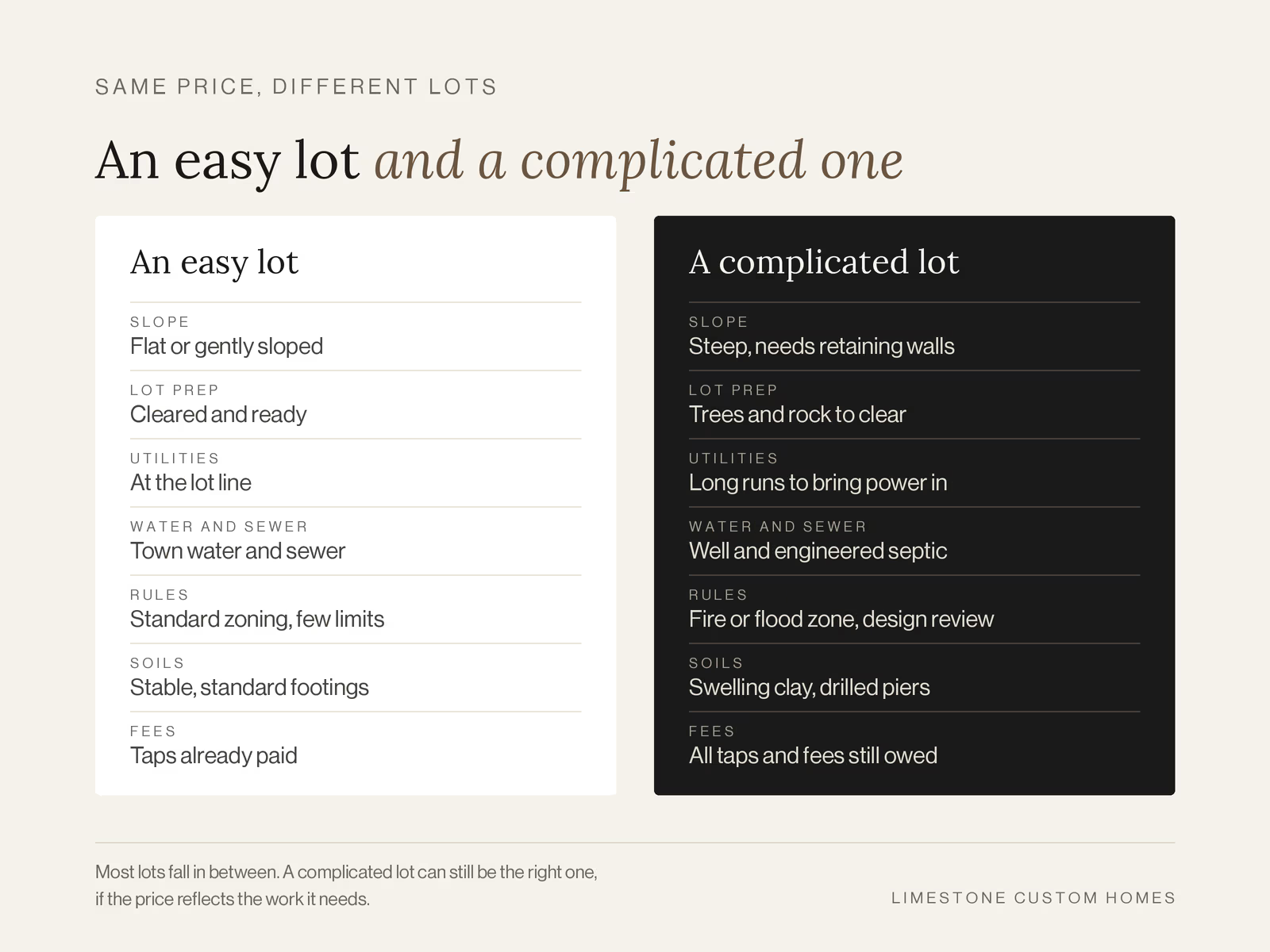
A complicated lot is not a bad lot. Some of the most beautiful sites in Colorado are steep, remote, or both. The point is to know what the lot needs before you agree on its price.
Paying for it
Land and construction are usually financed in two steps. Lenders often ask for a larger down payment on raw land than on a house. A construction loan is a short-term loan, usually at a higher rate than a mortgage, paid out in stages as the home is built. Some convert to a regular mortgage when the home is finished. Ask your lender how the land you own counts toward the loan.
Common questions
Is it cheaper to buy land and build a house?
Usually not. Buying an existing home tends to cost less. The statewide median single-family price reported in September 2026 was $590,000, and construction alone on a simple 2,400 square foot home starts around $600,000 before land and fees. People build to get the home and the site they want. Our guide to what a custom home costs in Colorado has the full numbers.
How much does it cost to buy land and build a house in Colorado?
Add four things: the land, construction at about $250 to $500 per square foot for a finished home, local fees, and design. Soft costs commonly add 15 to 25 percent to construction.
What is the best way to buy land and build a house?
Bring a builder or architect in before you buy and check what you can before the offer. Then write a due-diligence period into the contract and use it to confirm the survey, the zoning, the title, and the soils.
What questions should I ask when buying land?
Is the lot in a flood or wildfire zone? Which utilities reach the lot line? Which taps are paid? Is there a soils report? Who owns the mineral rights?
Can a builder help before I own the lot?
Most will. We walk lots with people before they buy, and thirty minutes on a call is enough to start.
Sources
- Limestone Custom Homes, the studio’s own experience on Colorado lots
- Colorado Real Estate Commission, Contract to Buy and Sell Real Estate (Land)
- Colorado State University Extension, Private Wells for Home Use
- Colorado Division of Water Resources, Denver Basin
- Code of Colorado Regulations, Regulation 43, site and soil evaluation
- Code of Colorado Regulations, floodplain rules, 2 CCR 408-1
- Colorado Geological Survey, Expansive Soil and Rock
- Colorado Municipal League, Colorado Wildfire Resiliency Code update, February 2026
- Douglas County Assessor, Mineral Interests
- Home Builders Association of Metro Denver, Development Fee Study, June 2025
- Consumer Financial Protection Bureau, What is a construction loan?
Limestone Custom Homes is a design-build studio in Castle Rock, Colorado, building custom homes, architectural renovations, and accessory dwellings across Douglas County, the Denver metro, and Larimer County.