By Limestone Custom Homes · Updated November 2026
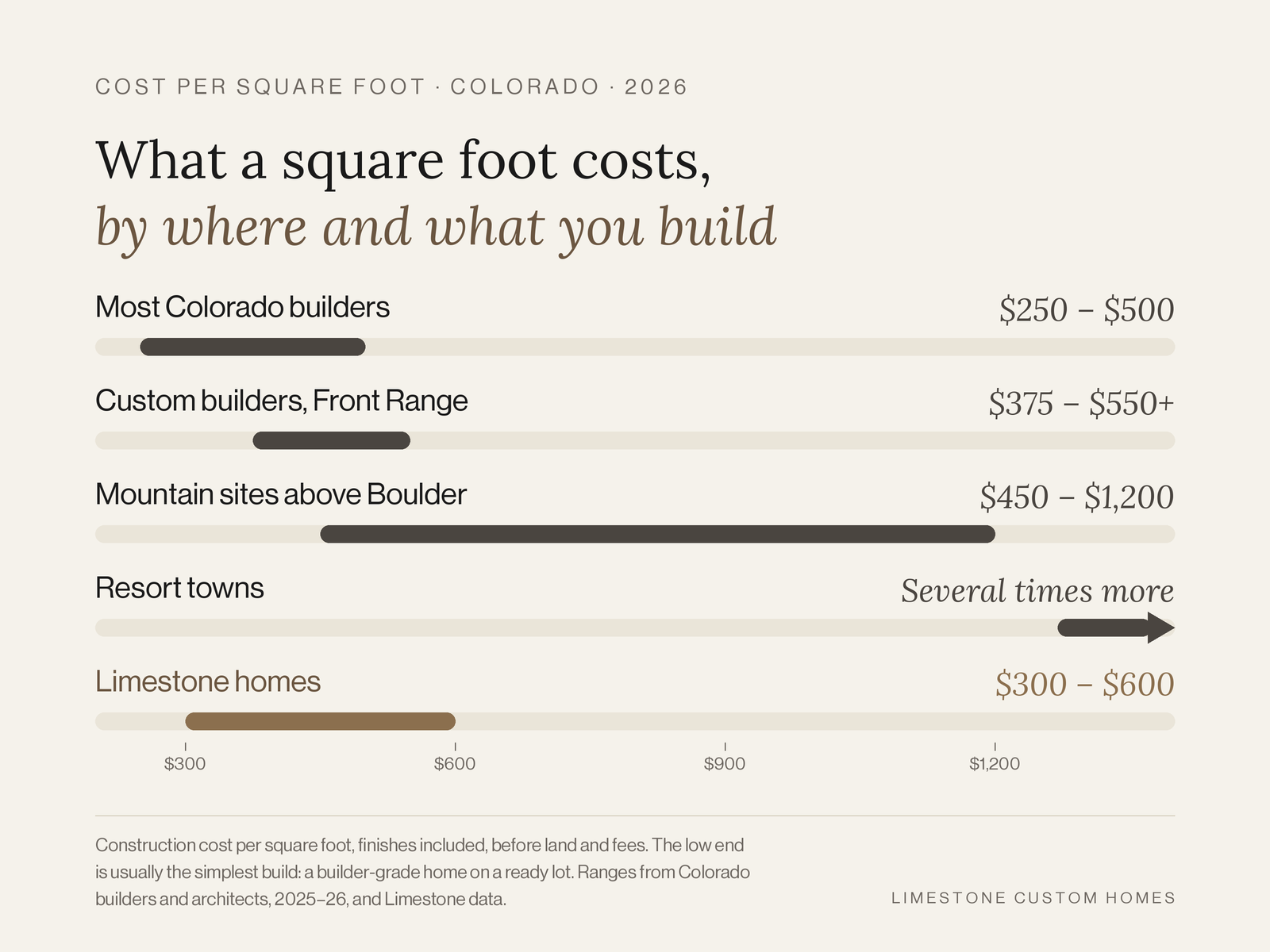
The short answer. Builders across Colorado quote about $250 to $500 per square foot for a finished home, and more in resort markets. Around $250 is the simplest build: a builder-grade home on a flat, ready-to-build lot. A mid-level custom home runs around $360, and a complex one $430 and up. Those prices include finishes. Land, design, landscaping, and local fees come on top.
For reference, the homes our studio builds start around $800K in hard construction cost, or roughly $1M to $1.1M once finishes are in. Most land between $1.5M and $2M, and some can reach $6M to $7M, or $500 to $600 per square foot. Other builders’ numbers will differ. The rest of this guide explains why the range is so wide.
The average cost to build a house in Colorado
There is no single average, because “a house” covers very different products. The most recent national figures come from the Census Bureau’s Survey of Construction. For homes started in 2025, NAHB’s analysis puts the median contract price of a custom home at $171 per square foot nationally, before the lot. In the Mountain states, which include Colorado, the median for a new spec home was $204 per square foot, also before the lot.
Those are medians across every size and finish level, so half of all homes cost more. Design-led custom homes on the Front Range sit well above them. Custom builders there publish numbers like $375 to $550 per square foot and up, and architects working above Boulder say a custom mountain home under $450 is rare.
Production, semi-custom, and custom
- Production. The builder’s plan on the builder’s lot, with options chosen from a list. The lowest cost per square foot.
- Semi-custom. A builder’s plan with changes, on their lot or yours. Priced in between.
- Custom. Drawn from scratch for one family and one site. The highest cost, because nothing is repeated.
When two quotes are far apart, check first that they describe the same kind of home.
Why the same 4,000 square foot home can cost $1M or $2M
Size sets the scale. At $250 to $500 per square foot, a 2,000 square foot home runs $500,000 to $1M in construction, and a 4,000 square foot home runs $1M to $2M. The bottom of that range is the simplest build: builder-grade finishes on a ready lot. How far above it a home lands depends mostly on five things.
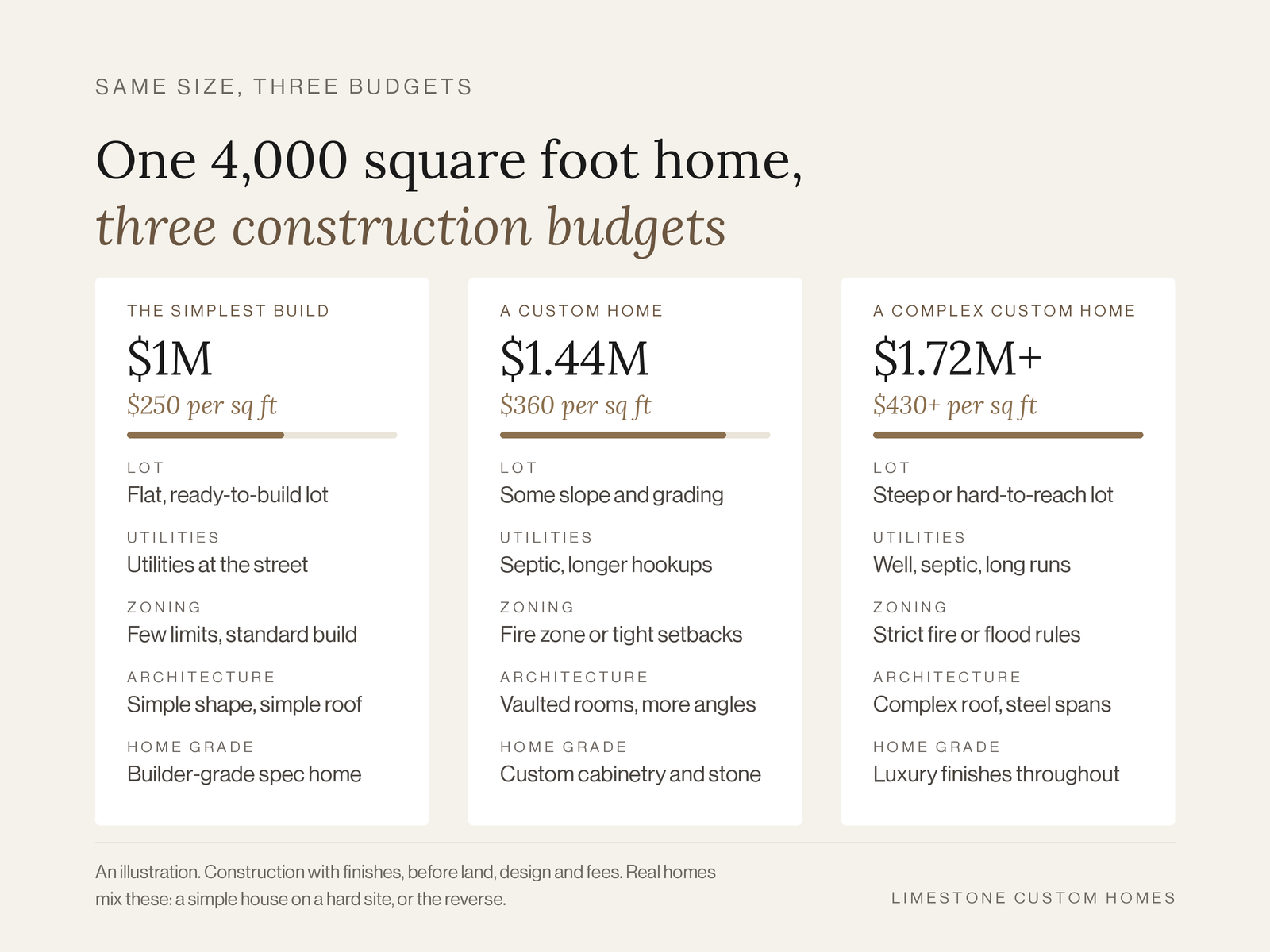
- The grade of the lot. A flat lot is the least expensive ground to build on. A slope means more excavation, a stepped foundation, and retaining walls.
- The utilities. An easy lot has water, sewer, power, and gas at the street. A complicated one needs a well, a septic system, or long runs to bring power and water in, and each one adds cost.
- The zoning. Every lot comes with rules. A wildfire zone calls for a fire-rated exterior. A flood zone means building above the flood level. Setbacks, height limits, and HOA design rules narrow what fits. The better the home fits the lot’s rules, the less it costs to build.
- The architecture. A simple shape with a standard roof is the least expensive home to build. More corners, a complex roofline, vaulted rooms, and long open spans all add engineering, steel, and labor.
- The grade of the home. Builder-grade, custom, and luxury are different price levels. The same kitchen footprint can cost several times more with custom cabinetry, natural stone, and integrated appliances.
How to compare prices per square foot
- Smaller homes cost more per square foot. Every home needs a kitchen, bathrooms, and heating and cooling, whatever its size. In a small home those costs are spread over fewer square feet.
- Builders measure square feet differently. One counts only the finished living space. Another also counts the garage, the basement, and covered patios, which makes the same house look less expensive per square foot. Ask what is being counted.
What “per square foot” leaves out
The prices in this guide cover building the house, finishes included. Not every quote works that way. Some builders quote hard cost alone and price finishes separately, so ask which one you are looking at. Landscaping and hardscaping, soft costs, and land usually sit outside the number.
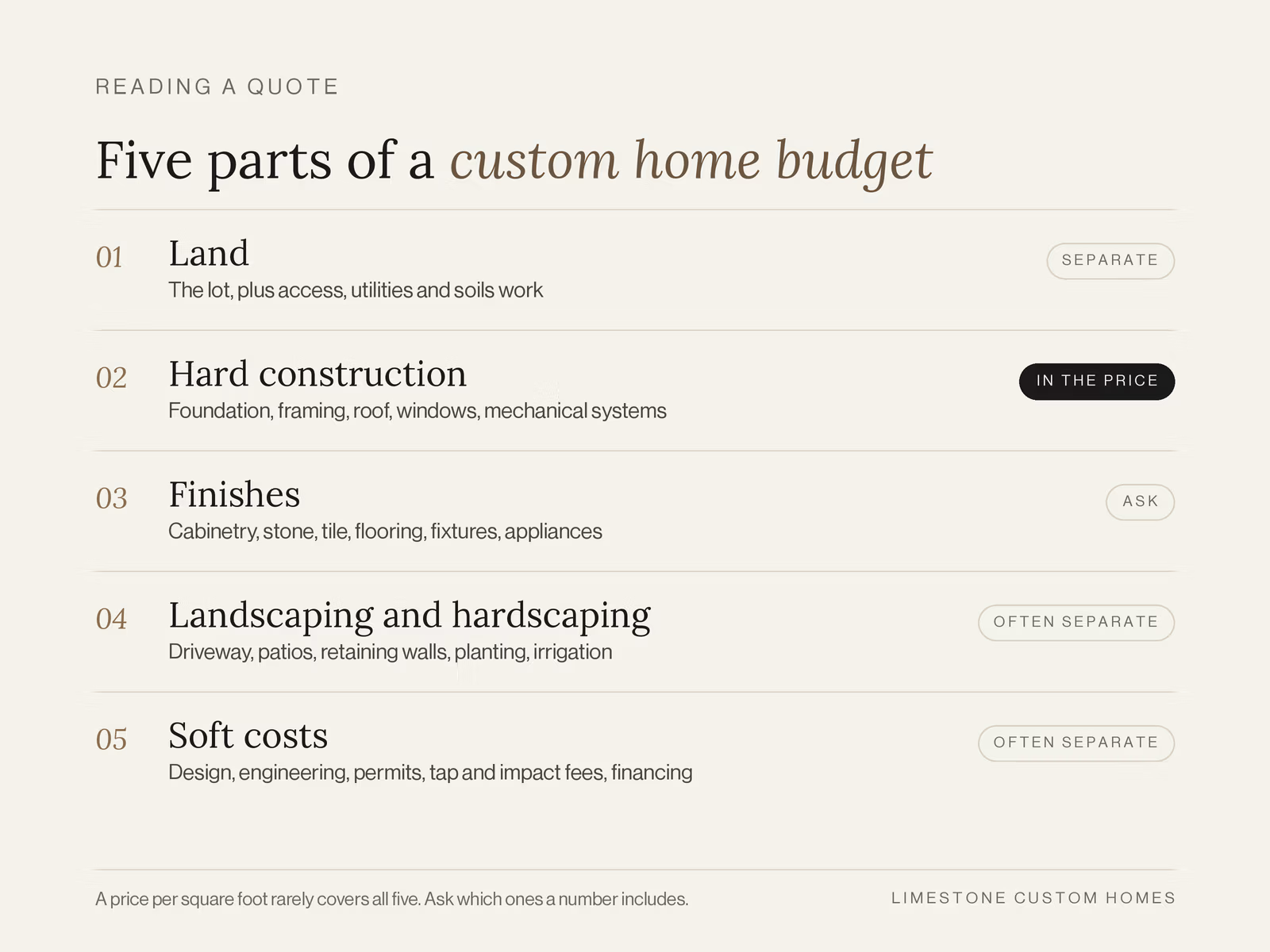
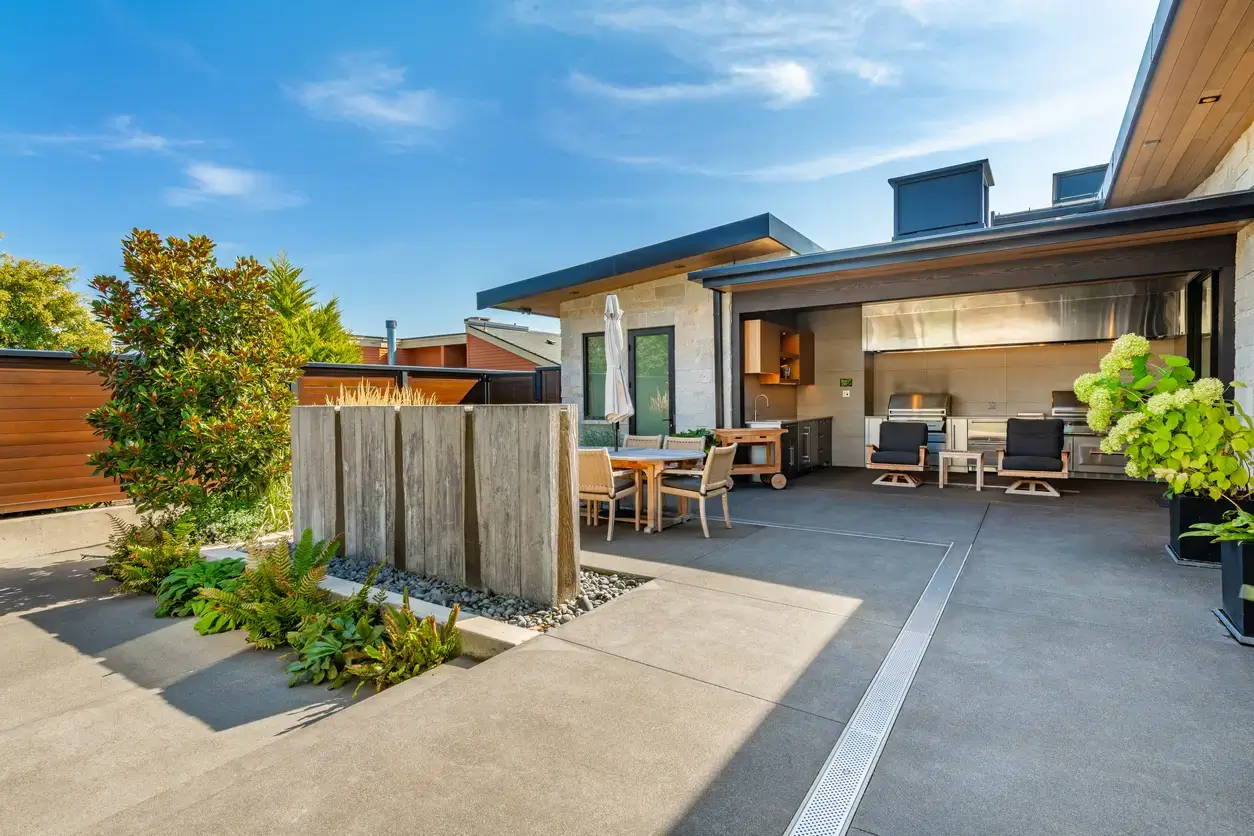
Landscaping and hardscaping are the part people forget. On a typical new home, NAHB’s construction cost survey puts landscaping, the driveway, and outdoor structures at about 5.6 percent of construction cost. A custom lot with retaining walls, patios, or an outdoor kitchen needs more.
Where you build matters almost as much as what you build
The area moves the price nearly as much as the lot, the finishes, and the build itself. A parcel in the mountains above Boulder takes more time and effort than a flat, ready-to-build lot near the city: longer access, harder ground, a shorter building season, and crews and materials that travel further.
Resort towns sit in a bracket of their own. Building in Aspen or Vail can cost several times more than on the Front Range.
Where the construction budget goes
NAHB’s construction cost survey also breaks the cost of a typical new home into stages. Interior finishes take the largest share at 24.1 percent, followed by plumbing, electrical, and HVAC at 19.2 percent and framing at 16.6 percent.
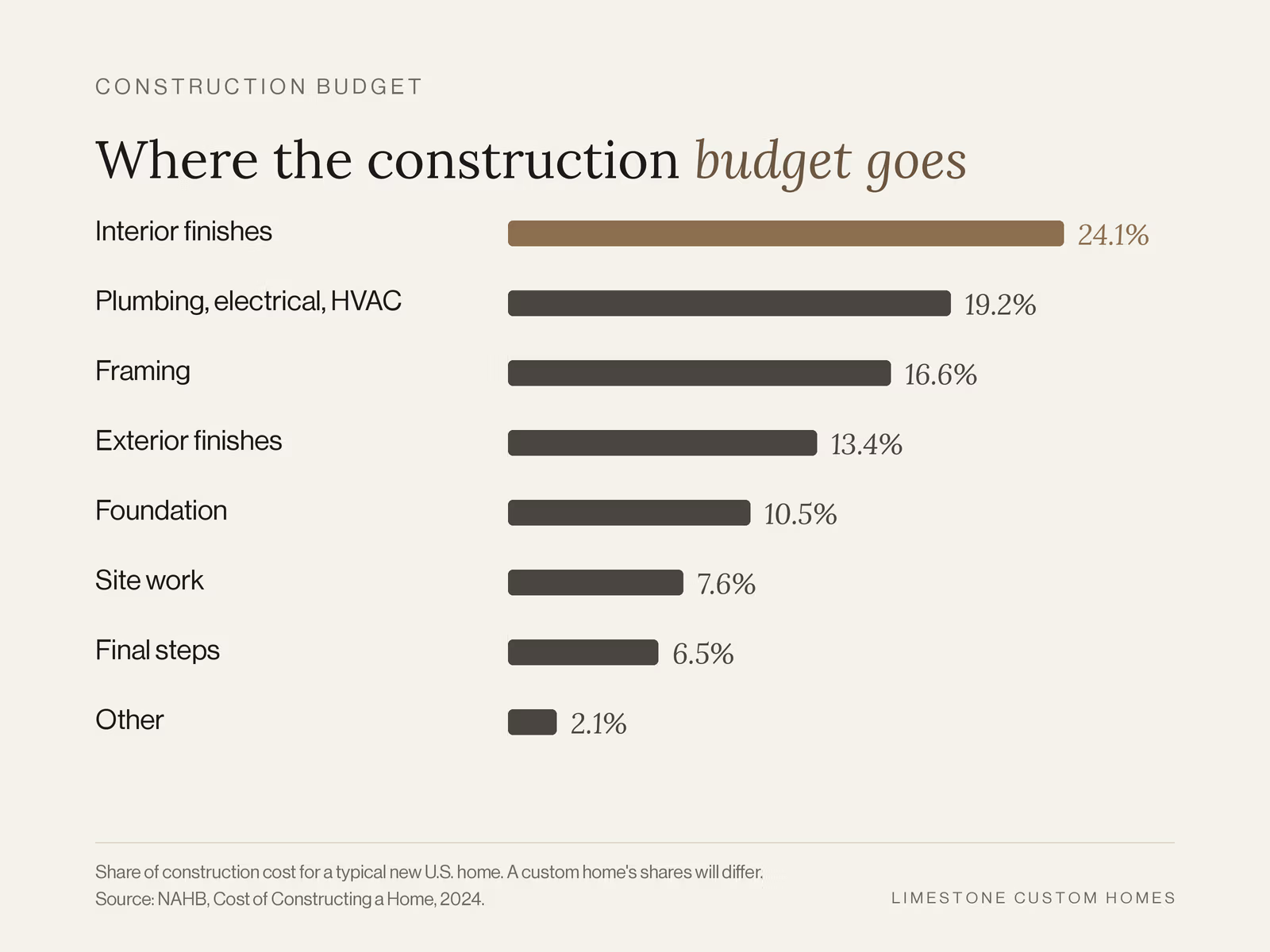
These are national averages for a typical new home. On a custom home the shares shift with what you choose.
The fees most quotes leave out
Local fees are easy to miss and large enough to matter. A 2025 study by the Home Builders Association of Metro Denver added up the building permit, use tax, impact fees, and water tap fee on a typical 2,400 square foot detached home in 16 jurisdictions. The metro average was about $68,000, and Castle Rock was the highest at about $94,000.
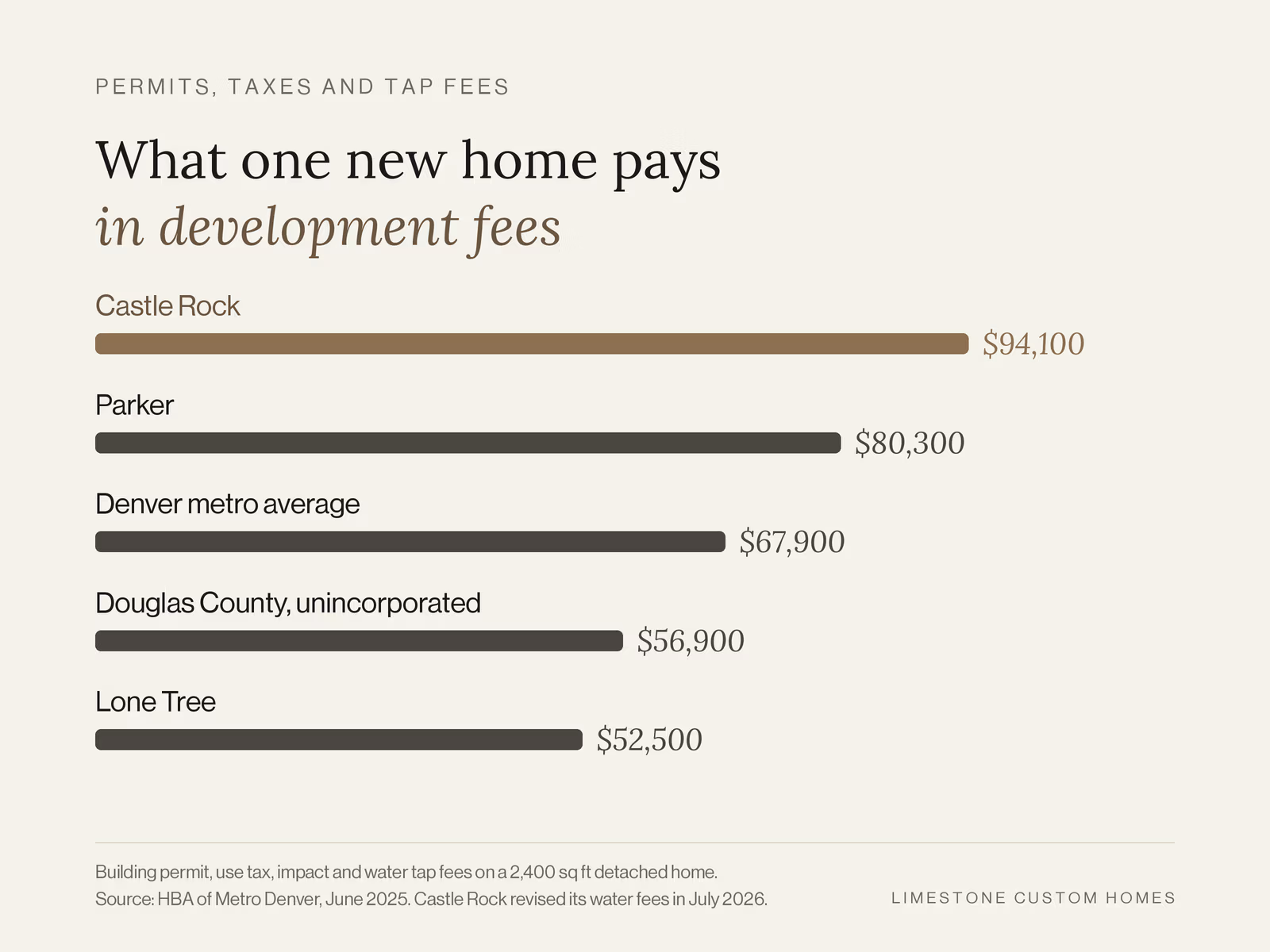
Treat those numbers as a floor. The study prices a 2,400 square foot home and counts four fees only. It leaves out utility connections, school and park land dedications, and HOA or metro district charges, and a larger custom home pays more on most lines. On one of our own builds in Larimer County, the fees, taps, utility connections, and HOA charges came to more than $150,000.
Water is the biggest piece. Under the schedule Castle Rock adopted in 2026, the water system development fee runs from $21,750 for a home under 2,000 square feet to $59,657 for a home of 7,500 to 7,999 square feet.
Add design and engineering, and soft costs commonly come to 15 to 25 percent of the construction cost. Ask any builder to show them as their own line.
What Colorado adds to the math
- Soils. The Colorado Geological Survey calls swelling clay the state’s most significant geologic hazard. Where it is present, the foundation is engineered to the soils report, often with drilled piers, and costs more than a standard footing. Order the soils report before you buy the lot, in Larimer County as much as in Castle Rock.
- Wildfire. Colorado adopted a statewide Wildfire Resiliency Code in 2025, and local governments had to put it in force by July 2026. If your lot is inside the mapped wildland-urban interface, plan for ignition-resistant materials and defensible space.
- Snow and wind. Roofs and frames are engineered for the loads at your specific site.
What changed for 2026
- Tariffs. Imported softwood lumber carries a 10 percent tariff. Imported kitchen cabinets and vanities carry 25 percent, and an increase to 50 percent is scheduled for January 1, 2027.
- Castle Rock water fees. The town restructured them in July 2026. Fees fell most for smaller homes.
- Wildfire code. It now applies at the local level, as described above.
Fixed budget or cost-plus
Most cost surprises on a custom home come from the contract, and both common types have a case.
In a cost-plus contract, the builder passes costs through with a margin. You see every invoice and can change your mind as you go, and the risk of an overrun is yours. In a fixed-budget contract, the price is set before construction. You get certainty, and in exchange the design has to be finished and priced before ground breaks.
Our studio works on fixed budgets, because the people pricing the home are the people who drew it. Other good builders work cost-plus. Whichever you choose, know who carries the risk before you sign.
How long it takes
Time is part of the price, because construction financing and your current housing both run for the whole build.
Census Bureau data, summarized by NAHB, shows that custom homes built by a contractor and finished in 2025 averaged 11.7 months of construction, from permit to completion. Homes over 6,000 square feet averaged 16.3 months. Our own construction runs 10 to 15 months.
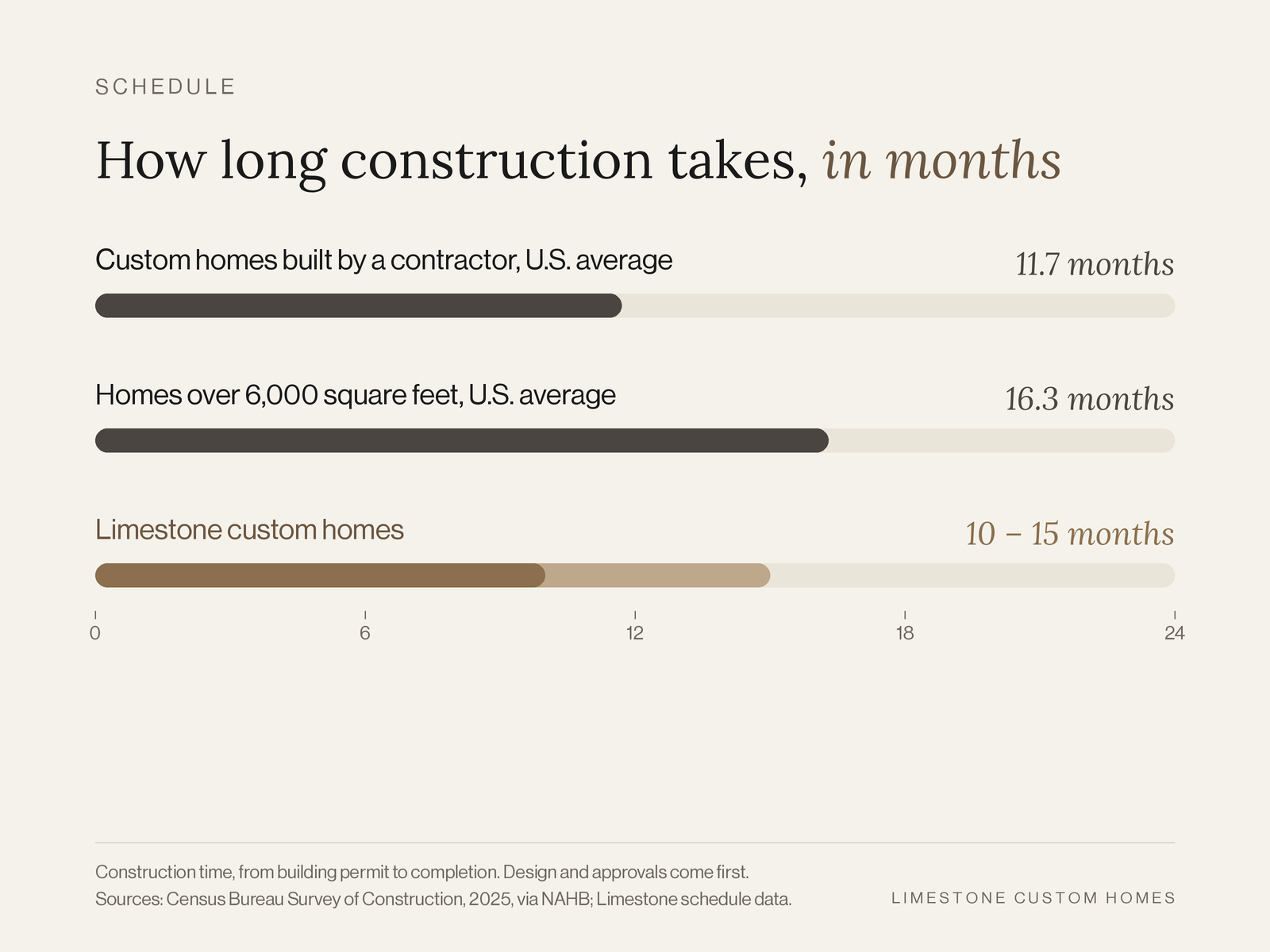
Design, pricing, and approvals come before the permit, and those figures leave them out. Counting everything from signed contract to keys, our builds run 12 to 22 months, depending on the size of the home, the location, and the complexity.
Common questions
Is it cheaper to build or buy a house in Colorado?
Buying an existing home is usually less expensive. For scale, the statewide median single-family price reported in September 2026 was $590,000, and construction alone on a 2,400 square foot home at $250 per square foot, the simplest builder-grade build, is $600,000 before land and fees. Many people weighing the two are also considering a renovation of the home they own, and sometimes that is the better answer.
How much does it cost to build a 2,000 square foot house in Colorado?
At $250 to $500 per square foot, construction runs $500,000 to $1,000,000 before land, design, and fees. The low figure is a simple, builder-grade home on a ready lot, and smaller homes tend to sit higher in the per-square-foot range.
Can a custom home be built for under $1M in Colorado?
Yes, in some areas and at some sizes. Our own homes start around $800K in hard construction cost, so it is possible with us too, on a ready lot with a simple plan and restrained finishes. Finishes usually bring that starting point to $1M or a little more. An accessory dwelling or a renovation has a lower entry point still.
Do I need to hire an architect separately?
It depends on the builder. A design-build firm holds architecture and construction under one contract. With a traditional builder, you hire the architect first and bring finished drawings. Both routes work. The difference is who coordinates the two.
What does a first conversation cost?
With most builders, nothing. Ours is thirty minutes with the people who would design and build the home. No deck. No pitch.
Sources
- Limestone Custom Homes, the studio’s own project pricing and build schedules
- National Association of Home Builders, Custom Home Premium Highest Since 2011, September 2026 (Census Bureau Survey of Construction, homes started in 2025)
- NAHB, Cost of Constructing a Home in 2024, the most recent edition of this survey
- NAHB, Single-Family Home Construction Time Declines in 2025 (Census Bureau Survey of Construction)
- Home Builders Association of Metro Denver, Development Fee Study, June 2025
- Denver Gazette, Castle Rock overhauls water fees, April 2026
- Denver Gazette, Does Aspen have the world’s most expensive real estate?, September 2026
- Colorado Geological Survey, Expansive Soil and Rock
- Colorado Municipal League, Colorado Wildfire Resiliency Code update, February 2026
- Associated Press via PBS News, tariffs on kitchen cabinets and vanities, January 2026
Limestone Custom Homes is a design-build studio in Castle Rock, Colorado, building custom homes, architectural renovations, and accessory dwellings across Douglas County, the Denver metro, and Larimer County.