By Limestone Custom Homes · Updated November 2026
The short answer. In design-build, one firm designs and builds your home under a single contract. In the traditional route, you hire an architect first and a builder second, under two contracts. Design-build gives you one team and an early read on cost. The traditional route gives you an independent designer and competing bids. Both build good homes. The right one depends on how much you want to manage, and how early you need a number.
We are a design-build studio, so read this knowing where we stand. We have tried to describe both routes fairly.
What design-build means
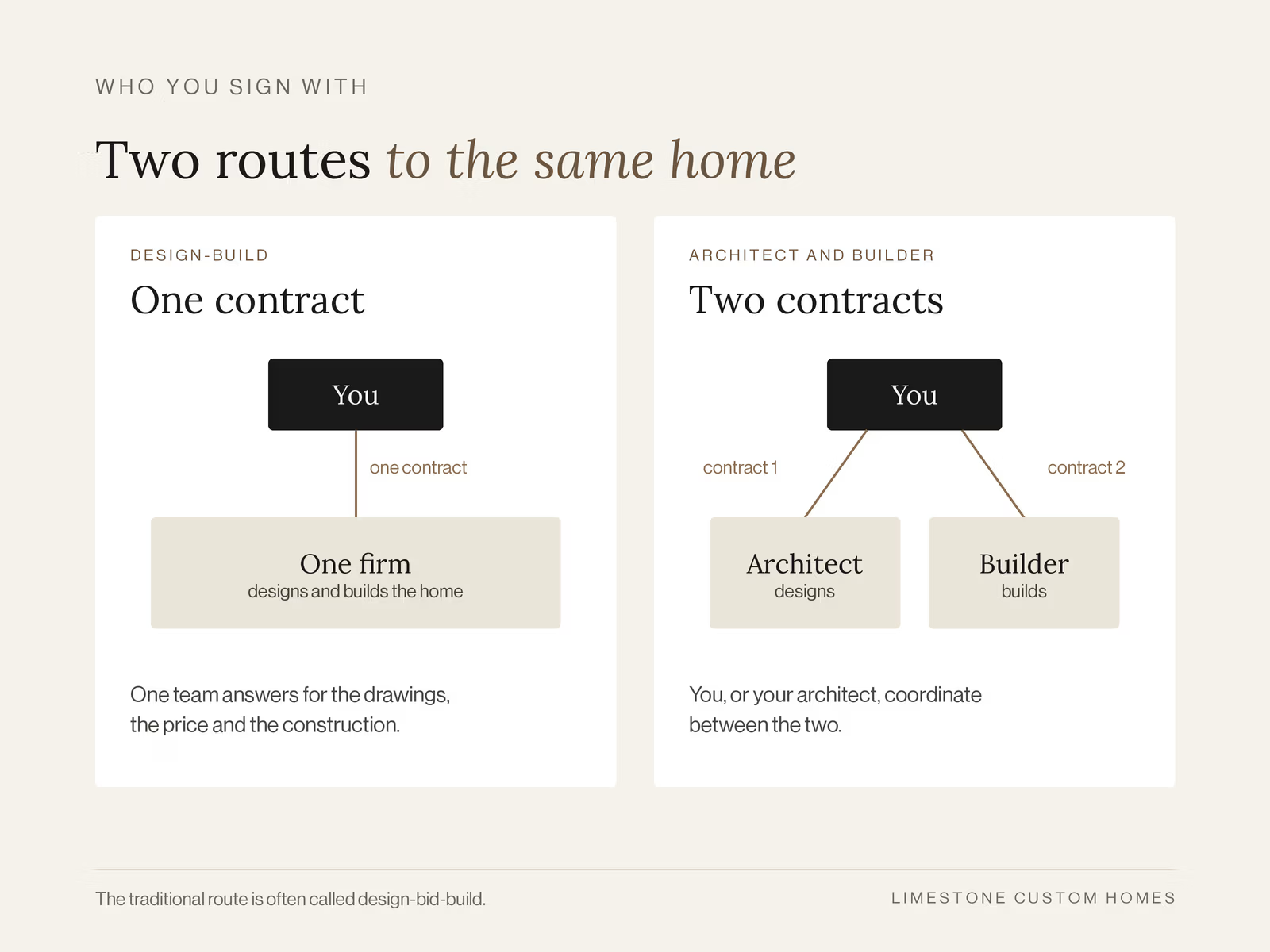
You sign one contract with one firm, and that firm is responsible for both the drawings and the construction. As AIA Contract Documents describes it, a design-build firm can be a builder with its own designers or a design firm that also builds.
The practical difference is that the people pricing the home sit next to the people drawing it. Cost is checked while the design is still on paper.
What the traditional route means
It is often called design-bid-build, after its three steps.
- Design. You hire an architect, who draws the home.
- Bid. The finished drawings go out to builders, who each give a price.
- Build. You pick a builder and sign a second contract.
You, or your architect on your behalf, coordinate between the two.
Many custom homes use a middle route. You hire an architect and bring a builder in early, to price the design as it develops and avoid surprises at bid time.
How the two compare
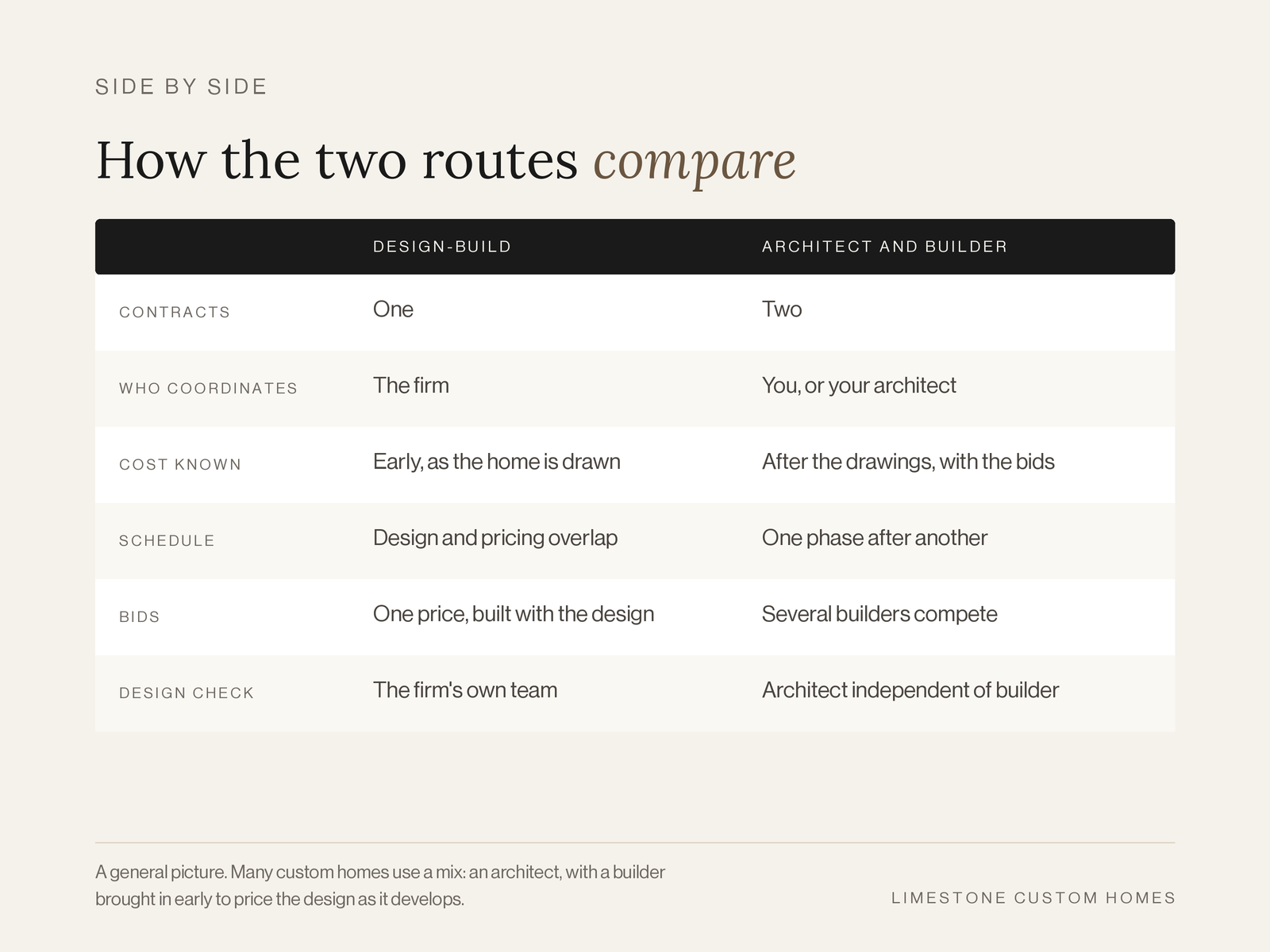
- Cost. In design-build, the builder prices the home as it is drawn, so a budget problem shows up early. In the traditional route, the real price arrives with the bids, after the drawings are done. If the bids come in high, the home goes back for redesign. Our guide to what a custom home costs in Colorado has the numbers.
- Time. The traditional steps run one after another. Design-build overlaps design and pricing, which usually shortens the path to breaking ground.
- Accountability. With one firm, one party answers for both the drawings and the building. With two, a gap between what was drawn and what was built can become a question of whose fault it is.
- Checks. In the traditional route, your architect is independent of the builder, and competing bids can bring the price down. In design-build you rely on one firm, so its record matters more.
There is some research on this. A 2018 study by the Construction Industry Institute and the Pankow Foundation found that design-build projects had 3.8 percent less cost growth and 1.7 percent less schedule growth than design-bid-build. Two cautions: it studied larger building projects, not custom homes, and the results were released by the design-build industry’s own association.
When each one fits
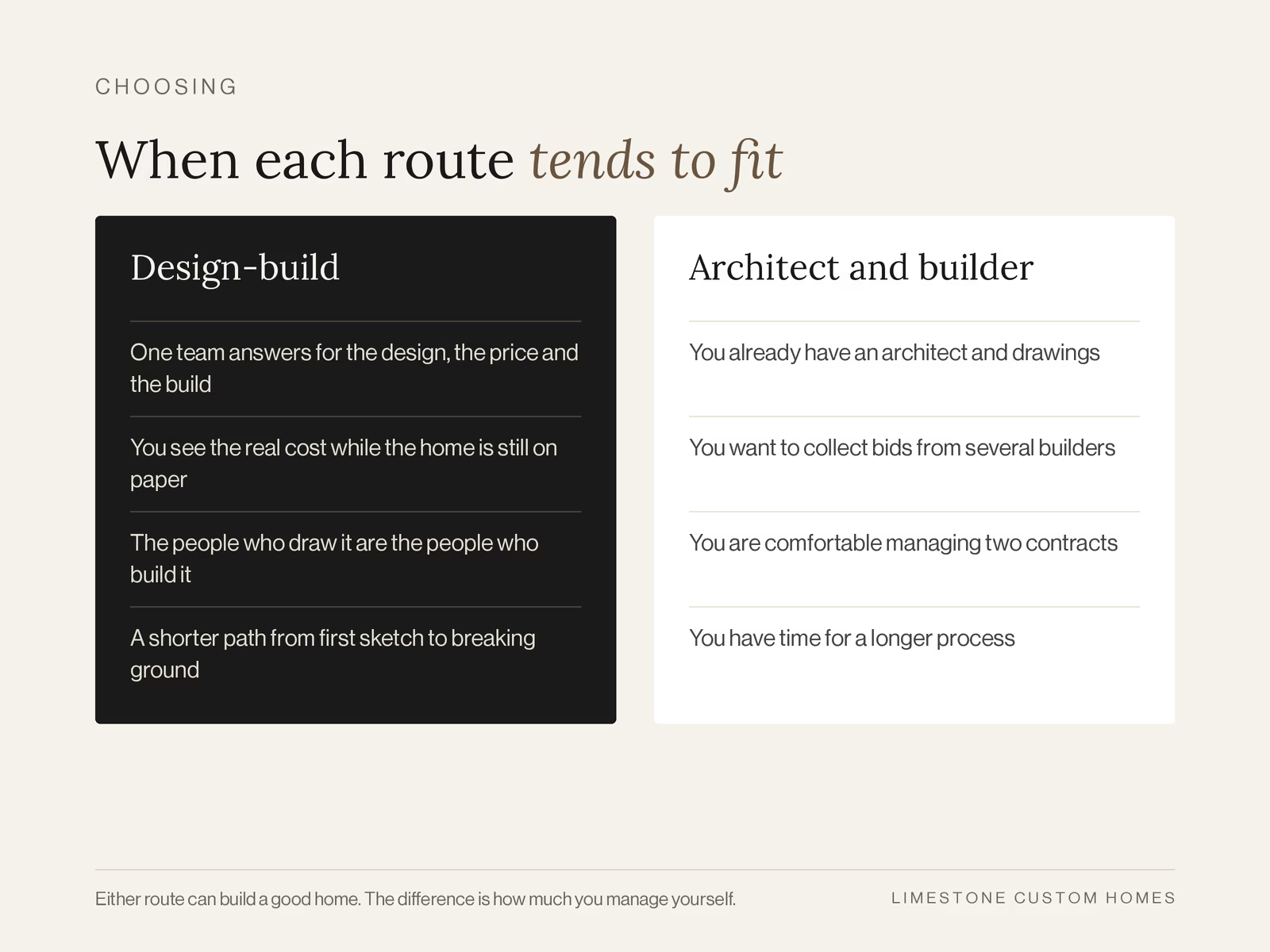
In our experience, design-build suits most people building one home for themselves. One team answers for the design, the price, and the construction, and you see the real cost while the home is still on paper.
Hiring an architect and a builder separately fits best when you already have an architect and drawings you love, and you are comfortable managing two contracts.
If that is you, a good design-build firm will tell you so.
Do you need an architect to build a house in Colorado?
Not by state law. Colorado’s licensing statute exempts one- to four-family homes, so a house can be designed by someone who is not a licensed architect.
That is a different question from whether you want one. Your town or county still enforces its building code, and a custom home needs careful design whoever draws it. Ask any firm who will design your home and what they have drawn before.
Common questions
Is design-build cheaper than hiring an architect and a builder?
Not by rule. Design-build skips competitive bidding, which can cost you. It also tends to catch budget problems before the drawings are finished, which can save you. Compare the whole cost, design fees included.
Is design-build faster?
Usually, because design and pricing happen together. The gain is mostly before construction starts.
What is the difference between design-build and a general contractor?
A general contractor builds from drawings someone else made. A design-build firm produces the drawings too.
Can I bring my own architect to a design-build firm?
Some firms will work that way. Ask early, because it changes who is responsible for the drawings.
Does the same choice apply to a renovation?
Yes. A major renovation can be run either way, and the trade-offs are the same.
How do I find out which route suits my project?
Talk to one of each. We work as a design-build studio, and thirty minutes on a call is enough to tell you honestly whether that fits your home. If you are still choosing land, start with what to check before you buy a lot.
Sources
- Limestone Custom Homes, the studio’s own experience as a design-build firm
- AIA Contract Documents, Design-Build vs Design-Bid-Build: Key Differences, Benefits, and Contract Frameworks
- Design-Build Institute of America, New Research Shows Design-Build Continues to Deliver Projects Most Efficiently, November 2018
- Colorado Revised Statutes, section 12-120-403, exemptions
Limestone Custom Homes is a design-build studio in Castle Rock, Colorado, building custom homes, architectural renovations, and accessory dwellings across Douglas County, the Denver metro, and Larimer County.